
Would you like to use renewable heat (e.g. from river or groundwater, geothermal energy, air, waste water, etc.) as a heat source for your heating system?
Do you discharge large amounts of heat into the environment, e.g. from refrigeration, in the form of warm, humid exhaust air streams or process cooling?
Would you like to reduce CO2 emissions and energy costs in your process heat supply?
YES?
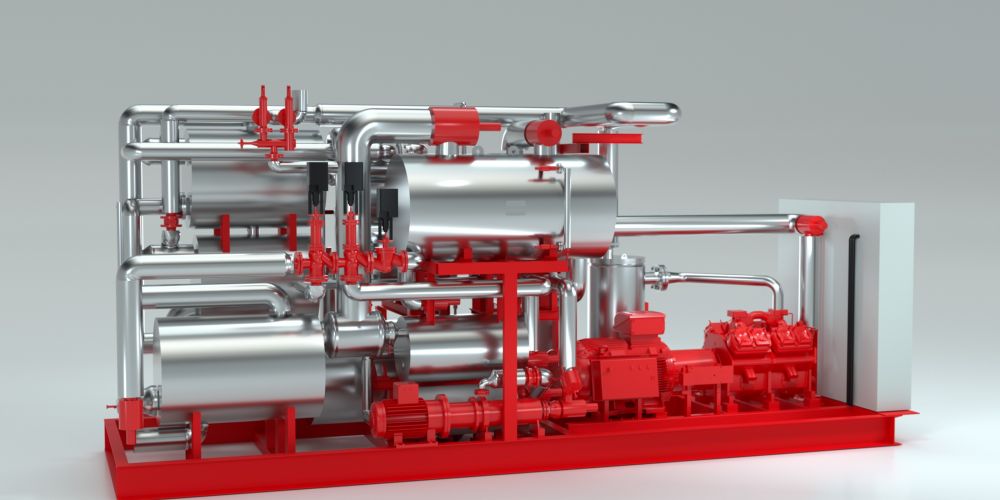
The AGO Caldora is an industrial heat pump that efficiently raises low-temperature heat to a higher usable temperature level across a wide range of capacities and temperatures.

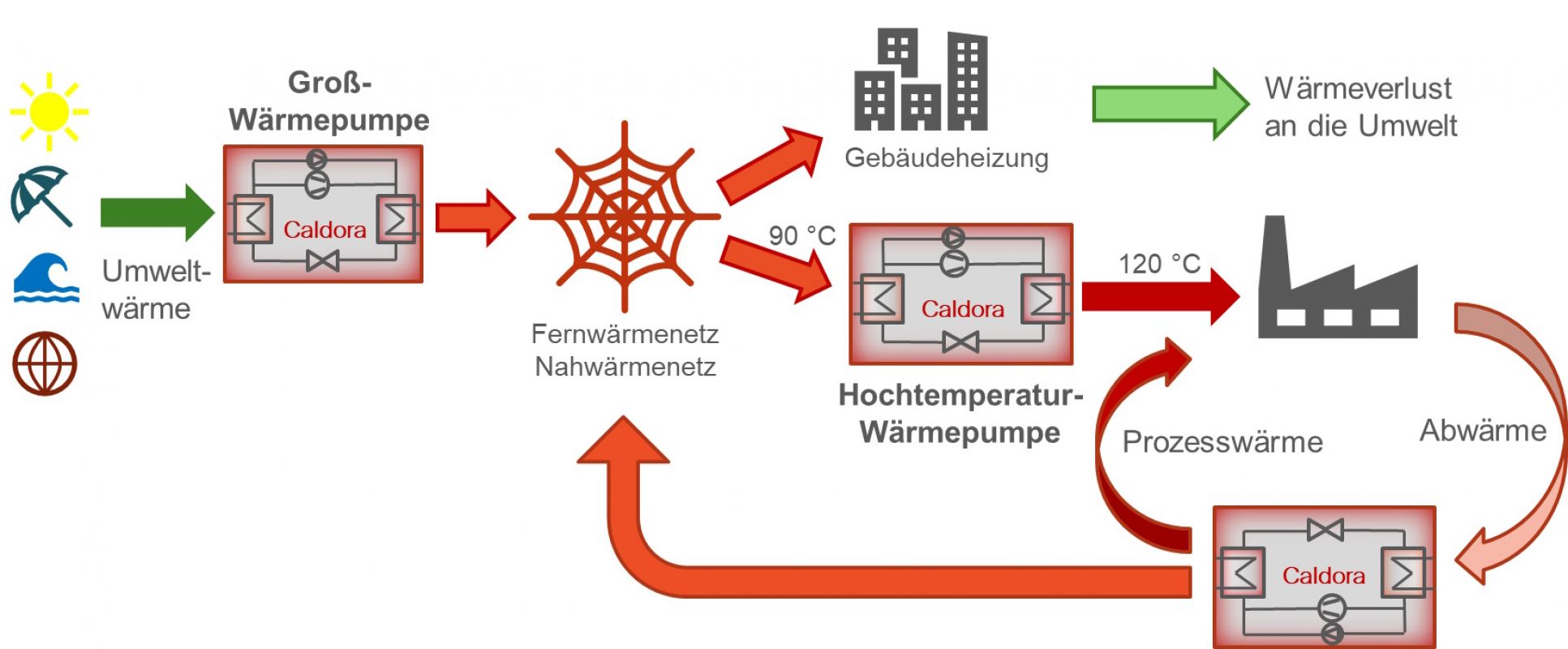
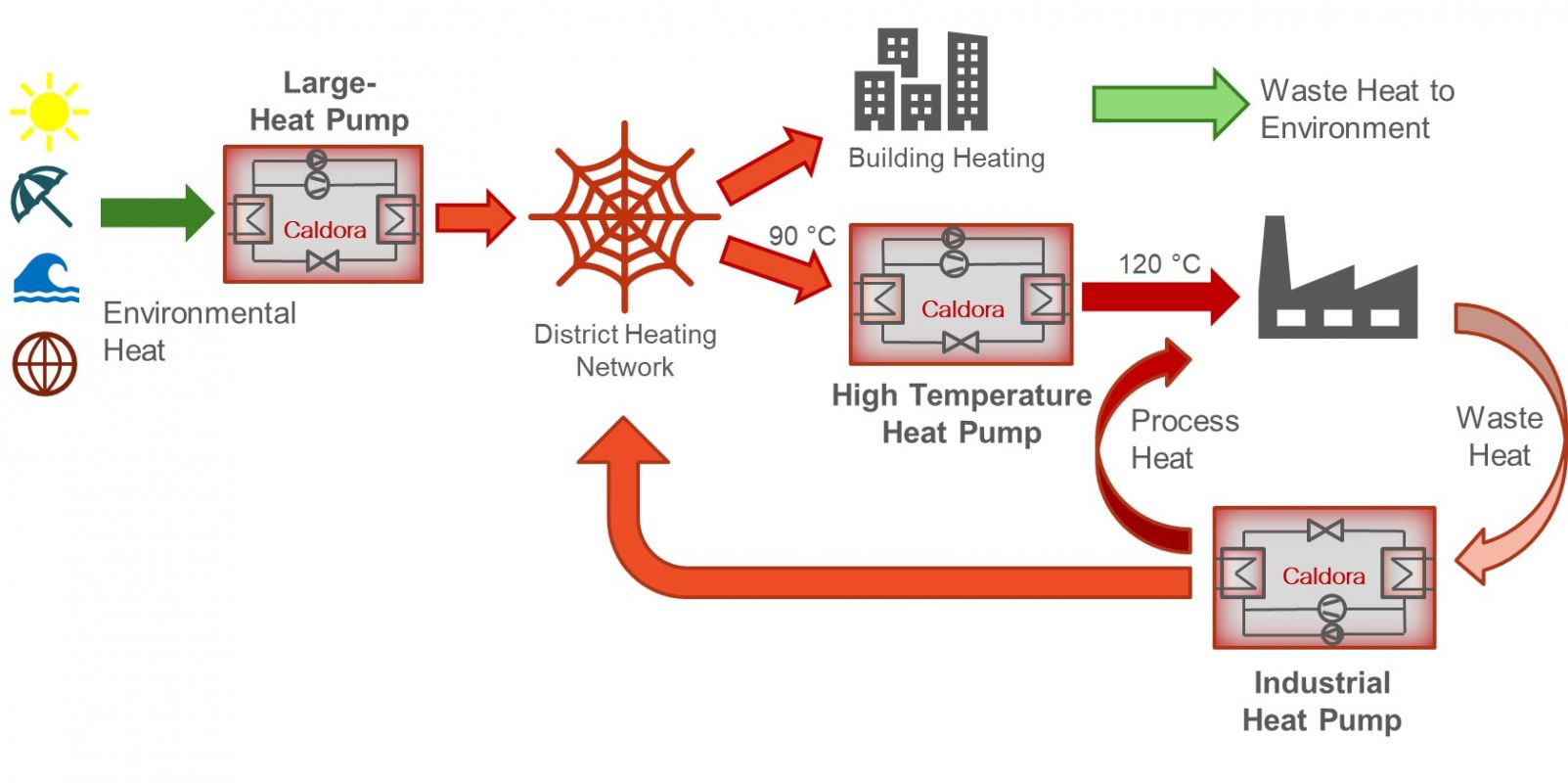
AGO Caldora as a large-scale heat pump
- Improved performance in deep geothermal heating systems
- District heating and process heat supply from environmental heat sources (groundwater or river water, air, solar thermal, etc.)
AGO Caldora as an industrial heat pump
- Combined process cooling and process heating supply
- Heat supply for CIP systems and simultaneous provision of process cooling
AGO Caldora high-temperature heat pump
- Heat recovery from drying processes (food drying, sewage sludge drying, gypsum drying, the drying section of paper machines, etc.)
- Flue gas or exhaust air condensation and heat recovery for processes requiring higher temperatures
Caldora High-Temperature Heat Pump:
Efficiency taken to a whole new level
Discover the innovative technology behind the Caldora high-temperature heat pump.
In our video, we show you how this revolutionary industrial heat pump operates efficiently even under extreme conditions and enables sustainable energy use.
AGO GmbH receives the Bavarian Energy Prize for its high-temperature heat pump for industrial and municipal heat supply
Application example
Technical data for heat pumps
- Heat source temperature: -10 °C to +90 °C
- Heat sink temperature: 50 °C to 160 °C
- Heating capacity: approx. 1,000 kW to 10,000 kW
- Coefficient of performance: dependent on temperature conditions
- Installation options: indoor installation, outdoor installation, in a container
How does an AGO Caldora heat pump work?


In a conventional heat pump, a refrigerant is vaporised at low pressure by absorbing heat from a heat source. The vapourised refrigerant is then compressed from low pressure to high pressure using a refrigerant compressor.
At high pressure, the refrigerant condenses, releasing heat to a high-temperature heating medium. The now liquefied refrigerant is then expanded from high pressure back to low pressure via an expansion valve to close the thermodynamic cycle.
In a heat pump with a solution cycle, such as the AGO Caldora, the heat exchanger used to cool the heat source is called a desuperheater rather than an evaporator. In this heat exchanger, a solution of ammonia and water is heated. The ammonia, which boils at a lower temperature, partially evaporates as a result, whilst the water remains liquid. In a subsequent separator, the two phases are separated.
As usual, a refrigerant compressor compresses the refrigerant vapour from low pressure to high pressure. In parallel, a solution pump pumps the resulting ammonia-depleted solution from low pressure to high pressure. Both flows are then fed together into the absorber.
In this heat exchanger, the ammonia vapour dissolves back into the aqueous solution. This process is called absorption and is an exothermic process. The heat generated in the process is transferred to the heating medium. The solution, which is now rich in ammonia again, is then expanded from high pressure to low pressure in a throttle valve to close the cycle.
Advantages of the AGO Caldora heat pump
We use an ammonia/water solution as the working medium. This offers the following advantages:
- Use of a natural refrigerant (GWP=0; ODP=0)
- The pressure level can be adjusted by setting the ammonia concentration, regardless of the temperature levels of the heat source and heat sink.
- Relatively low operating pressures are possible even at high heat sink temperatures.
- A high temperature spread on the heat source and/or heat sink side significantly increases efficiency.
- Power consumption is significantly lower in this case than with alternative heat pumps using single-component refrigerants.
- Suitable for use across a very wide temperature range on both the heat source and heat sink sides.
- Compressors from renowned European manufacturers are used.
- All tanks, heat exchangers and piping are made of stainless steel, ensuring long service life and reliability.
Cost-effectiveness and financing
The cost-effectiveness of these systems depends on legal, energy-related and technical framework conditions, the current subsidy situation and project financing. We would be happy to assist you with cost-effectiveness calculations and comparing different options. We will provide you with reliable data on the reduction of greenhouse gas emissions.
Together with RheinEnergie AG, we can also draw up a contracting proposal for you with the following benefits:
- RheinEnergie AG bears the cost of financing the plant, as well as the plant and operational risks.
- The investment does not appear on your balance sheet.
- The systems are operated and maintained by experts in energy supply systems.
- You can concentrate on your core business.
- High plant availability can be guaranteed.
Enquiry details:
Your application is unique. AGO Caldora is designed and manufactured to precisely suit the applications of our customers and contractual partners. For the design, we require the following parameters:
- Heat sources or heating capacity
- Flow and return temperatures of the heat source
- Flow and return temperatures of the useful heat
- Installation type (indoor, outdoor, in a container)
Take advantage of the funding opportunities available through the Bafa and KfW funding schemes for the construction of your thermal engineering system!
We’d be happy to advise you!
